Sunday, November 26, 2006

Cochise County pilgrimage

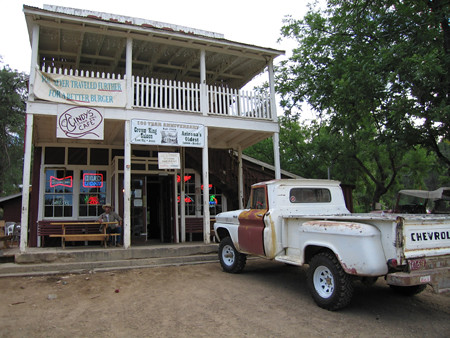
This Thanksgiving we took a trip to Cochise County. Ever since we found the hotel where my grandparents met in 1917 (and discovered that it is still in business) we have been wanting to go for a visit. But we went dirt-roading first, visiting the old Butterfield Stagecoach Station on the northern edge of the Dragoon Mountains, then drove into the mountains to check out Dragoon Springs. The Station was essentially a stockade with 10-foot unmortared stone walls and two teeny (5x5') rooms. It was really only used for 2 years due to the Civil War, Apache raids and the success of the Pony Express.

The temperature? 75 degrees (23.8 Celsius). What a lovely day!

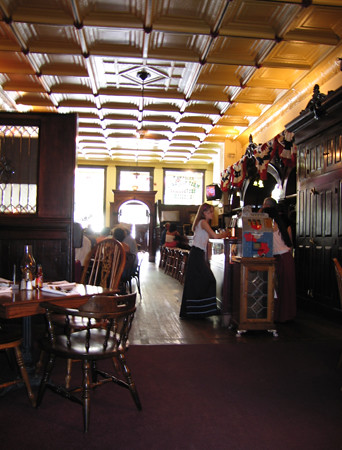
Dinner at the Hotel Cochise was down-home delicious. The dining room was filled with local folks, the owner Carla's kids and a trio of bikers who had made the trip from Phoenix.

More photos can be seen on my photogallery at Flickr.

Here is my Aunt Margie's account of how grandma (Julia) and grandpa (Allan) met:
In 1917 Julia met a young man on the steps of the Cochise Hotel. Her father didn't want to introduce her and told her he was "some Eastern chap from Harvard." Brother Philip arrived late for his train and in his hurry his suitcase fell open with everything falling out. The young chap sprang to help repack and the introduction followed. Of course Allan proceeded to court Julia.

Sunday, July 16, 2006

Favorite roses

Right now, my favorite rose is Reine des Violettes, a Hybrid Perpetual that has fuschia/violet colored blooms, hardly any thorns and a true-rose fragrance. Even the foliage is fragrant so when I deadhead it my hands smell seriously wonderful.

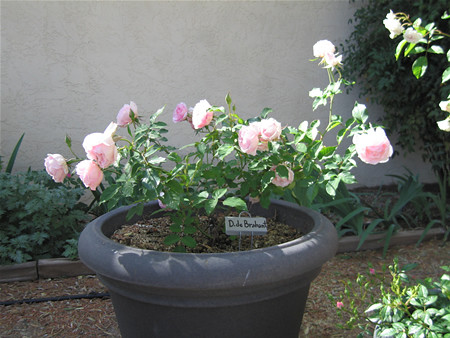
However, some of my new roses are going to be contenders. Tradescant is blooming its head off in the 100+ heat, bearing deep red blooms that are textured like butterfly wings. And Pat Austin (left) isn't stingy with its glowing orange/yellow/blush flowers.

Saturday, July 15, 2006

Container gardening in the desert

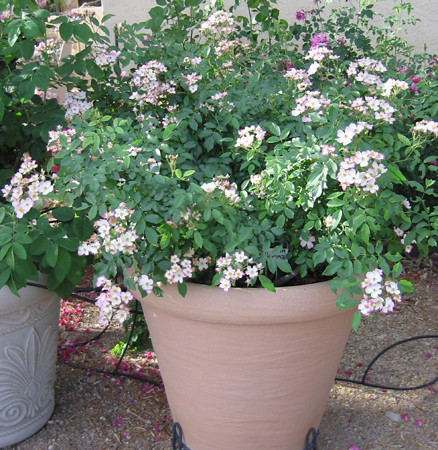
When I had my open garden this spring people were surprised that many of my roses were in pots. Ever since then I have wanted to write about my observations about using pots in the desert.

CONS: It is true that roots dry out and get hot faster for plants in pots. Additionally, our winds here in Tucson have knocked over many of my larger roses and damaged their canes and root systems. And finally, potted plants must be re-potted every 3-4 years when the soil line shrinks because of loss out the bottom and compaction. That isn't a problem with small plants but it is not fun to pull a 10 ft. rose out of its pot. Some gardening books will also tell you that you need to fertilize more often and that it is impossible to mulch but I have not found this to be true.

PROS: Pots allow you to move a plant that needs more protection from the wind or sun, as well as to control the quality of its soil more easily (our native soil is dreadful for roses). Re-potting lets you check the health of a plant's root system: I have discovered crown gall and grub infestations during the repotting process. And finally, if you have large aggressive trees it is easier to protect the plants from root competition. Many of Tucson's most experienced Rosarians (Les, Terry, Lou and Judy) also keep their roses in pots, so I am in good company.

Here's what I have developed as "best practices" for my yard:

About the pots
Use light-colored synthetic pots of good size. True terracotta is lovely but it is too porous and dries out too easily. I have my cacti and succulents in terracotta and my roses in plastic or foam pots.
--New roses are in pots that are 6-8 inches across.
--Mature miniatures and patio roses are in pots 8-12 inches across.
--Standard roses and climbers are in 20-24 inch pots.

I learned the hard way that the cheapest pots that the hardware stores sell (thin plastic usually colored beige, green or terracotta) sun-rot in about a year. They're just not worth the money in the long-run. On the other hand, all of my foam, thick plastic or double-walled pots have lasted for 7 years and counting.

About the soil
I like Uni-gro potting soil which doesn't have a whole lot of pricey additives, but just the right amount of peat and vermiculite. To this I will add triple super-phosphate and occasionally Epsom salts to aid root growth. I try to get a soil line about 1 inch from the rim to allow for mulch.

To protect from tree roots and cut down on sow bugs and crickets many of my roses are slightly raised above the ground on plant trivets. An added plus is that the antelope squirrels and lizards love the cool shade under the roses.

My garden is totally organic, and it gets better every year. Every year I notice more lacewings, crab spiders and lady bugs and fewer aphids and white flies. Most of the damage to my roses these days is caused by pack rats and quail (quail eat the young growth but only in the spring when they are laying their eggs). We trap the rats and tolerate the rest.

Wednesday, July 05, 2006

Gold Rush backcountry trip

Just back from a long weekend exploring Prescott and the Bradshaw Mountains. The weather was absolutely perfect: cool, cloudy days, light rain showers, and evenings that got down to the low 60s. Just the tonic we needed in the middle of a Tucson summer!

Today we took the Senator Highway through the gold rush country, driving down the road that the stagecoaches traveled from Prescott to the mining camps in the Bradshaw Mountains. Most of the towns have left no trace; it is likely the stones and lumber were scavenged and used elsewhere. We drove through Palace Station (1875), Goodwin (1882), Bradshaw City (1863), Crown King (1888), Cleator (1901) and Bumblebee (1879).

At Palace Station the stage coach stop is still there, a simple log cabin with a huge apple tree out front. At Goodwin I found 2 building foundations and something even more precious: a rose bush that I think was part of a settler's garden. At first I thought it was the wild mountain rose, Rosa woodsii, but then I realized that the thorns were all wrong and that there was also mint growing nearby. I dug up two pieces that had suckered and we'll see if they survive a Tucson summer.

Crown King was a real hoot. It was the site of Arizona's richest gold mine and so prosperous that by late 1897 it had a post office, a company store, several saloons, two Chinese restaurants, and a feed yard. We expected it to be fairly modern and all commercialized, but it was the real thing! Crown King still has the state's oldest standing saloon and brothel, today a saloon and cafe. I was tickled by the sign on the door: "Friday and Saturday nights: Dogs cannot be in the Saloon after 8:00 p.m. due to prior dog fights / bites. All other times they must be on leash." We had our dog Arrow with us and he was totally welcome inside, as were several local dogs: Atlas, Scruffy and Kisses.

The road back to I-10 took the path of the 1890s railroad (Murphy's Impossíble Railroad, aka Prescott and Eastern Railroad) so I tried to imagine taking the trip by train. At least it kept my mind off the roughness of the dirt road =).

The trip took a lot longer than we expected: 6 hours (including our picnic at Goodwin) to Crown King and 2 hours from Crown King to the highway. All on dirt roads, but some of the prettiest scenery I've seen in a long time.

8/2: My "Goodwin Mystery Rose" has rooted! Yeah!

Thursday, June 08, 2006

Toads go "Maaa"

The 2 days of rain mean that the spadefoot toads have emerged from underground and are mating. It sounds like a combination of the sound of a whoopie cushion and a lamb bleating.

I had a nice afternoon in Nogales, Son. with my sister-in-law and her daughter. I found a sweet Talavera platter for my sister and a killer silver necklace for me!

Wednesday, June 07, 2006

Wet stuff

Rain! Honest-to-goodness rain! And here June is usually our driest month. It has rained the last 2 afternoons and I am leaving the windows open because it smells so good.

We spent a lovely morning at the Desert Museum. We went early in the morning and were rewarded by seeing many of the animals that are usually hidden in the shady areas: wolves, mountain lions, javelina, bobcats, and box turtles. But the highlight was watching a baby hummingbird from 2 feet away as mama bird fed it nectar and fruitflies. The baby's head was smaller than my pinkie nail and the nest was about an in-and-a-half wide. It's just one of those things that you feel honored to see.

I also bought a squeaky toy in the shape of a chili pepper for Arrow and Rosie.

Sunday, May 07, 2006

Predator Spring

No that's not a movie, that's my backyard. Tucson is deep in a drought and my yard isn't full of quail families and baby cactus wrens checking for yummy bugs this year.

Around December, a pair of Cooper's Hawks moved in and made a charnel of the earth under one of our mesquite trees. Squab legs & carcasses and woodpecker feathers now decorate my yard. Animals are vulnerable this year because the desert is so parched that you can hear it crackle. Now cats or bobcats and snakes have moved in and I am finding pieces of ground squirrel amongst my roses. A few weeks ago we hosted a king snake, and last night we saw our first baby rattlesnake. And not one family of quail.

We're all praying for rain.

Wednesday, May 03, 2006

Snake

I have a snake in my garden. It's a scary feeling to be watering or picking weeds and see what you know is a snake out of the corner of your eye.

Once I figured out that I was actually a safe distance I tried to figure out: friend or foe? Triangular head? No. Rattle? No. Diamond patterning? Yes! Oooh, and it is shaking the tip of its tail as if it had a rattle! I've never seen a King Snake do that before.

I look at my watch. My guests are arriving in 15 minutes. What would you do?

Photos of the rose garden

why

Mutabilis means "changeable" in Latin; it is also the name of one of my favorite roses. I think it is a good metaphor for life -- and gardening -- in general.

Here you will find my gleanings on various subjects, but my garden, the Sonoran desert, and travels around the state of Arizona.

Tuesday, November 30, 2004

The wall of my dreams

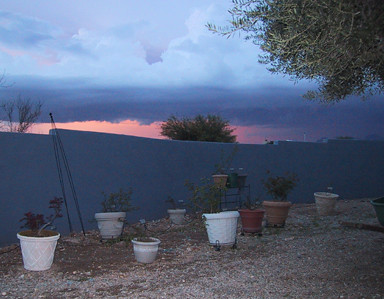
We finished the wall on the north end of our property, and it is everything I hoped for. I wanted a wall so that I could landscape the yard without worrying about javelina eating everything tender and juicy. I also wanted a wall that was eye catching and elegant.

I had two inspirations. One was a wall I saw in a magazine that undulated instead of running straight. The second inspiration was my friend Abbie's ranch house in Patagonia which she painted a color that is not blue, purple or gray, but a mix of all three that matches the color of storm clouds. I fell in love with the way greens and pinks and apricots "pop" against its color. As you can see in the photograph, the color comes pretty close!

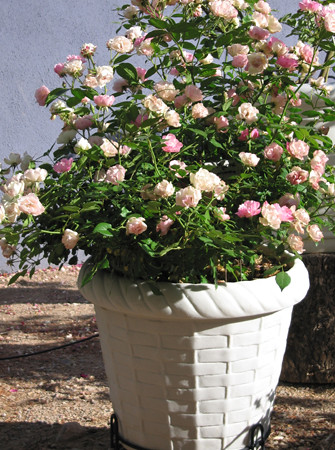
To celebrate, I moved my rose pots out from the backyard where they weren't getting enough sunlight. Now what to do with the rest of the yard?

Contractor: Larry Magda, a neighbor who is also a builder.