Saturday, March 29, 2008
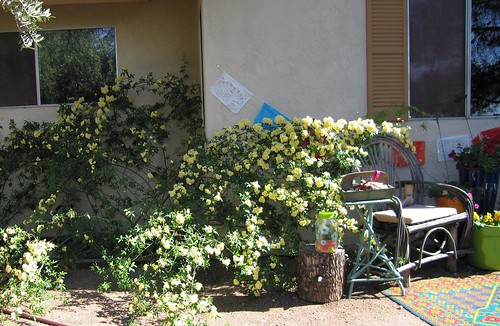
Garden party!
Sunday, January 27, 2008
La Rose Impériale
From the Huntington website:
“La Rose Impériale: The Development of Modern Roses” will showcase 110 rare illustrated herbals and rose books, including a first edition of Pierre-Joseph Redouté’s glorious multivolume work, Les Roses (1817-24). The exhibition is the anchor of a yearlong celebration of the 100th anniversary of the Rose Garden at The Huntington, which was established by the institution’s founders Henry and Arabella Huntington in 1908."
Pruning time!
Here in the desert it is rose-pruning time. This year I am hard pruning several of my larger roses to make it easier to re-pot them, or move them to larger pots. I don't normally do this with my teas and chinas.
I am also trying an experiment with my beloved Bourbon roses. For years I have been following the advice to prune them as you would a hybrid tea. For Mme. Isaac Pereire and Mme. Ernst Calvat this has been fine. For the other two (Louise Odier, Mme. Pierre Oger), I have ended up with older canes that are just a mess, and not very productive. It is like the wood gets too hard to send new growth out. So this year I am pruning out many of these older canes and leaving the long, younger canes that are 1-2 years old, and pegging them. I hope this creates plants that I will love even more. Thank goodness they are all in pots so I can easily make room for the pegged canes. Pictures coming!
Here are some links to good information on pruning OGRs in a warm climate:
I am also trying an experiment with my beloved Bourbon roses. For years I have been following the advice to prune them as you would a hybrid tea. For Mme. Isaac Pereire and Mme. Ernst Calvat this has been fine. For the other two (Louise Odier, Mme. Pierre Oger), I have ended up with older canes that are just a mess, and not very productive. It is like the wood gets too hard to send new growth out. So this year I am pruning out many of these older canes and leaving the long, younger canes that are 1-2 years old, and pegging them. I hope this creates plants that I will love even more. Thank goodness they are all in pots so I can easily make room for the pegged canes. Pictures coming!
Here are some links to good information on pruning OGRs in a warm climate:
Sunday, September 30, 2007
Memory: My secret garden
Did you read The Secret Garden as a child? Did you ever fantasize about finding your own secret place like that? We did.
My husband and I lived in El Paso, TX for a while, and loved to take day trips into New Mexico. Usually it was to Mesilla, a charming town that used to be the territorial capital of the area that covered what is now Arizona and New Mexico. Our other favorite trip was to go to Cloudcroft and Ruidoso in the Sacramento Mountains where it was nice and cool; we would typically stop for a picnic lunch along the way.
One year (1989?) we stopped and pulled over into the towering trees in the town of Tularosa, and discovered a wondrous garden. You see, Tularosa has what is called a "water district," a part of town where the water flows freely through acequias, shallow, unlined ditches beside the road. Anyone who lives in the district gets water for flood irrigation via the acequias. The cottonwood and walnut trees are nearly the size of sequoias, and small farms abound.
There in the shade of one of the huge cottonwoods we could see a tangled garden and a tiny adobe house beyond. As we were finishing lunch, a man came over from across the street, introduced himself as Mr. Domingues, and he told us the story of the garden.
It turns out that the little adobe was the second house built by the Spanish when they settled the area in the 1860s, and because water is so plentiful, most of the original plantings have survived: Manzana de San Juan (apples), figs, grapes, and roses. Mint and sweet peas were also running wild. Carey and I were both amazed. I can't think of any gardens in the desert southwest where the original plantings have been preserved! Without water they quickly wither and die, but the acequia system kept this garden alive.
Years later, when I knew more about heritage gardens and roses, I wrote to the "rose rustlers" of New Mexico to see if they would take cuttings so the rose would be preserved if something happened to the garden. Our conversation is actually preserved on someone's website! [Peaceful Habitations Roses]. Obviously this page hasn't been updated since 2002. I will have to give them a call and see what happened.
My husband and I lived in El Paso, TX for a while, and loved to take day trips into New Mexico. Usually it was to Mesilla, a charming town that used to be the territorial capital of the area that covered what is now Arizona and New Mexico. Our other favorite trip was to go to Cloudcroft and Ruidoso in the Sacramento Mountains where it was nice and cool; we would typically stop for a picnic lunch along the way.
One year (1989?) we stopped and pulled over into the towering trees in the town of Tularosa, and discovered a wondrous garden. You see, Tularosa has what is called a "water district," a part of town where the water flows freely through acequias, shallow, unlined ditches beside the road. Anyone who lives in the district gets water for flood irrigation via the acequias. The cottonwood and walnut trees are nearly the size of sequoias, and small farms abound.
There in the shade of one of the huge cottonwoods we could see a tangled garden and a tiny adobe house beyond. As we were finishing lunch, a man came over from across the street, introduced himself as Mr. Domingues, and he told us the story of the garden.
It turns out that the little adobe was the second house built by the Spanish when they settled the area in the 1860s, and because water is so plentiful, most of the original plantings have survived: Manzana de San Juan (apples), figs, grapes, and roses. Mint and sweet peas were also running wild. Carey and I were both amazed. I can't think of any gardens in the desert southwest where the original plantings have been preserved! Without water they quickly wither and die, but the acequia system kept this garden alive.
Years later, when I knew more about heritage gardens and roses, I wrote to the "rose rustlers" of New Mexico to see if they would take cuttings so the rose would be preserved if something happened to the garden. Our conversation is actually preserved on someone's website! [Peaceful Habitations Roses]. Obviously this page hasn't been updated since 2002. I will have to give them a call and see what happened.
Saturday, September 29, 2007
September garden update
I just finished doing the fall pruning and fertilizing, and almost everything survived the summer quite well, even though June was unusually hot and the summer rains a bit sparse. Unfortunately, one favorite rose (Pat Austin!) died. Back in May, the soil seemed too wet so I moved its emitter to another pot -- then forgot about it. Not good.But the ones that made it are thriving. Mme. Isaac Pereire has finally started sending out long, long canes. Right next to her is Ballerina, and she is playing copycat. Flower Girl, less than one year old, is looking quite promising and Charles Austin has earned its place amongst my favorites because it is so reliably and fragrantly in bloom. My Goodwin Creek Mystery Rose [story] should flower next spring! What was different? Timed release fertilizer (I hate fertilizing when it is hot), and once it got over 100 degrees I set the irrigation to water twice a day for 30 minutes.
So now I am planning what to buy bareroot and what to get rid of. This year I will say goodbye to miniature rose Neon Cowboy and China rose Louis Phillipe. Neon Cowboy blows open too fast in my garden, and Louis Phillipe has been stingy with the bloom. I may get rid of La Marne too because its blooms are too fragile.
Here is my wishlist for new roses (I will probably only buy 2 or 3): Charles de Mills, Fortune's Double Yellow, Happy Chappy, Heaven on Earth, Jacqueline du Pré, Lilian Austin, Marchesa Boccella, Mme. Alfred Carierre, Pillow Fight, Queen of Bourbons, Rosette Delizy, Verdun and Westerland. Which ones should I choose?
Monday, April 30, 2007
My Mystery Roses
I have amassed a small collection of roses that I am trying to identify. See if you can guess what they might be! I have given them "study names" until I can discover their true one. "Mystery roses" are also called "Found roses" and "Lost roses." If this intrigues you, you should read Thomas Christopher's book In Search of Lost Roses.
This one was given to me by Rose Society member Kacie Johnson. She bought it in Oregon, but has no idea what it could be because pack rats ate the labels off all her pots. It has been tentatively identified as Shailer's Provence, which is truly exciting because SP has a wonderful history -- it was one of the roses that Thomas Jefferson grew in his garden at Monticello.
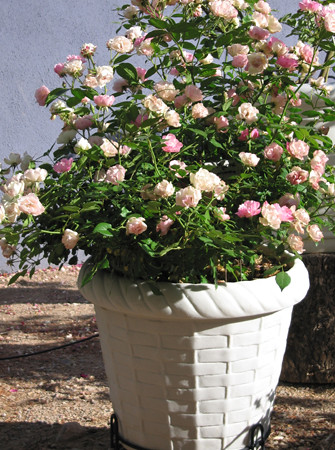
This vigorous rose has a strong, damask-like fragrance and suckers freely. It only blooms in the springtime.
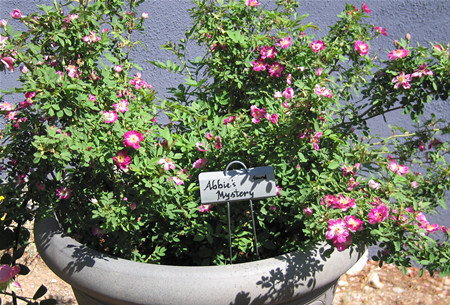
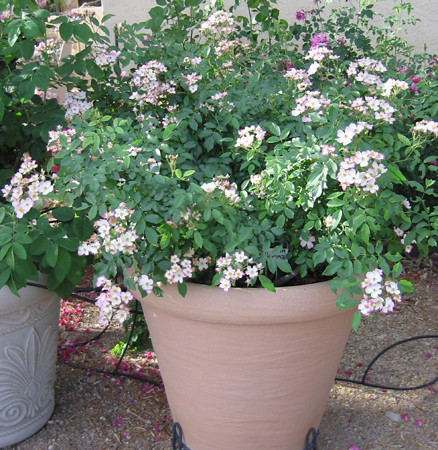
This delicate rose came from my friend Abbie's 100-year-old ranch house in Patagonia, AZ. I have given it the study name of "Abbie's Mystery." It suckers like mad and produces tiny magenta flowers with a white eye. It is not fragrant. Abbie leaves during the summer for long periods of time and this rose has survived without watering!
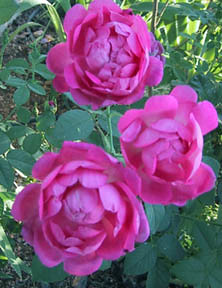
This rose also came to me from a Rose Society member. She propagated it from a rose that grew at her mother's house. Ive had it for 4 years and this is only the second year it has bloomed. As you can see it definitely has old rose form. The growth habit is like a Bourbon rose -- long and leggy (though you don't see that here). It's very fragrant. Study name: "RST Mystery."
And finally, "Goodwin Creek Mystery Rose." This picture comes from the source plant which we found along a creek near the old gold mining camp called "Goodwin" in the Bradshaw Mountains. There was also mint growing wild nearby so I like to think that both were escapees from a miner's garden. This rose has not bloomed for me yet. It does not seem to be Rosa woodsii.
This vigorous rose has a strong, damask-like fragrance and suckers freely. It only blooms in the springtime.
This rose also came to me from a Rose Society member. She propagated it from a rose that grew at her mother's house. Ive had it for 4 years and this is only the second year it has bloomed. As you can see it definitely has old rose form. The growth habit is like a Bourbon rose -- long and leggy (though you don't see that here). It's very fragrant. Study name: "RST Mystery."Friday, March 30, 2007
Planning for the Future
This week Carey and I contracted with Landscape Designer Jean Lewis for a multi-stage design for our yards. This is so exciting! Finally I will have a framework and a cohesive plan for the future. This will mean we can finally install real irrigation (right now it is faucet-based), finish the rose garden, tie the back and side yards together visually, and (yay!) build a potting shed.
We asked for a plan that we could implement in stages. I will let you know how it goes!
Sunday, November 26, 2006
Cochise County pilgrimage
This Thanksgiving we took a trip to Cochise County. Ever since we found the hotel where my grandparents met in 1917 (and discovered that it is still in business) we have been wanting to go for a visit. But we went dirt-roading first, visiting the old Butterfield Stagecoach Station on the northern edge of the Dragoon Mountains, then drove into the mountains to check out Dragoon Springs. The Station was essentially a stockade with 10-foot unmortared stone walls and two teeny (5x5') rooms. It was really only used for 2 years due to the Civil War, Apache raids and the success of the Pony Express.The temperature? 75 degrees (23.8 Celsius). What a lovely day!
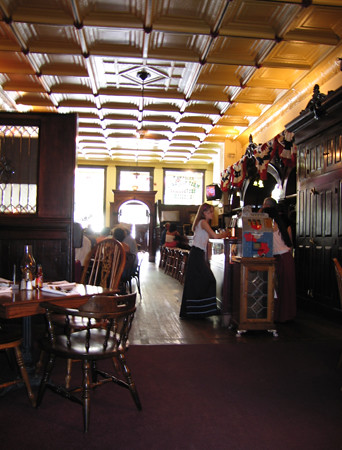
Dinner at the Hotel Cochise was down-home delicious. The dining room was filled with local folks, the owner Carla's kids and a trio of bikers who had made the trip from Phoenix.More photos can be seen on my photogallery at Flickr.
Here is my Aunt Margie's account of how grandma (Julia) and grandpa (Allan) met:
In 1917 Julia met a young man on the steps of the Cochise Hotel. Her father didn't want to introduce her and told her he was "some Eastern chap from Harvard." Brother Philip arrived late for his train and in his hurry his suitcase fell open with everything falling out. The young chap sprang to help repack and the introduction followed. Of course Allan proceeded to court Julia.
Labels:
CochiseCounty,
dirtroads,
Dragoon,
Rockfellow,
trips
Sunday, July 16, 2006
Favorite roses
Right now, my favorite rose is Reine des Violettes, a Hybrid Perpetual that has fuschia/violet colored blooms, hardly any thorns and a true-rose fragrance. Even the foliage is fragrant so when I deadhead it my hands smell seriously wonderful.
However, some of my new roses are going to be contenders. Tradescant is blooming its head off in the 100+ heat, bearing deep red blooms that are textured like butterfly wings. And Pat Austin (left) isn't stingy with its glowing orange/yellow/blush flowers.
Saturday, July 15, 2006
Container gardening in the desert
Here's what I have developed as "best practices" for my yard:
About the pots
Use light-colored synthetic pots of good size. True terracotta is lovely but it is too porous and dries out too easily. I have my cacti and succulents in terracotta and my roses in plastic or foam pots.
--New roses are in pots that are 6-8 inches across.
--Mature miniatures and patio roses are in pots 8-12 inches across.
--Standard roses and climbers are in 20-24 inch pots.
I learned the hard way that the cheapest pots that the hardware stores sell (thin plastic usually colored beige, green or terracotta) sun-rot in about a year. They're just not worth the money in the long-run. On the other hand, all of my foam, thick plastic or double-walled pots have lasted for 7 years and counting.
About the soil
I like Uni-gro potting soil which doesn't have a whole lot of pricey additives, but just the right amount of peat and vermiculite. To this I will add triple super-phosphate and occasionally Epsom salts to aid root growth. I try to get a soil line about 1 inch from the rim to allow for mulch.
To protect from tree roots and cut down on sow bugs and crickets many of my roses are slightly raised above the ground on plant trivets. An added plus is that the antelope squirrels and lizards love the cool shade under the roses.
My garden is totally organic, and it gets better every year. Every year I notice more lacewings, crab spiders and lady bugs and fewer aphids and white flies. Most of the damage to my roses these days is caused by pack rats and quail (quail eat the young growth but only in the spring when they are laying their eggs). We trap the rats and tolerate the rest.
Wednesday, July 05, 2006
Gold Rush backcountry trip
Today we took the Senator Highway through the gold rush country, driving down the road that the stagecoaches traveled from Prescott to the mining camps in the Bradshaw Mountains. Most of the towns have left no trace; it is likely the stones and lumber were scavenged and used elsewhere. We drove through Palace Station (1875), Goodwin (1882), Bradshaw City (1863), Crown King (1888), Cleator (1901) and Bumblebee (1879).
The road back to I-10 took the path of the 1890s railroad (Murphy's Impossíble Railroad, aka Prescott and Eastern Railroad) so I tried to imagine taking the trip by train. At least it kept my mind off the roughness of the dirt road =).
The trip took a lot longer than we expected: 6 hours (including our picnic at Goodwin) to Crown King and 2 hours from Crown King to the highway. All on dirt roads, but some of the prettiest scenery I've seen in a long time.
8/2: My "Goodwin Mystery Rose" has rooted! Yeah!
Thursday, June 08, 2006
Toads go "Maaa"
The 2 days of rain mean that the spadefoot toads have emerged from underground and are mating. It sounds like a combination of the sound of a whoopie cushion and a lamb bleating.
I had a nice afternoon in Nogales, Son. with my sister-in-law and her daughter. I found a sweet Talavera platter for my sister and a killer silver necklace for me!
Wednesday, June 07, 2006
Wet stuff
Rain! Honest-to-goodness rain! And here June is usually our driest month. It has rained the last 2 afternoons and I am leaving the windows open because it smells so good.
We spent a lovely morning at the Desert Museum. We went early in the morning and were rewarded by seeing many of the animals that are usually hidden in the shady areas: wolves, mountain lions, javelina, bobcats, and box turtles. But the highlight was watching a baby hummingbird from 2 feet away as mama bird fed it nectar and fruitflies. The baby's head was smaller than my pinkie nail and the nest was about an in-and-a-half wide. It's just one of those things that you feel honored to see.
I also bought a squeaky toy in the shape of a chili pepper for Arrow and Rosie.
We spent a lovely morning at the Desert Museum. We went early in the morning and were rewarded by seeing many of the animals that are usually hidden in the shady areas: wolves, mountain lions, javelina, bobcats, and box turtles. But the highlight was watching a baby hummingbird from 2 feet away as mama bird fed it nectar and fruitflies. The baby's head was smaller than my pinkie nail and the nest was about an in-and-a-half wide. It's just one of those things that you feel honored to see.
I also bought a squeaky toy in the shape of a chili pepper for Arrow and Rosie.
Sunday, May 07, 2006
Predator Spring
No that's not a movie, that's my backyard. Tucson is deep in a drought and my yard isn't full of quail families and baby cactus wrens checking for yummy bugs this year.
Around December, a pair of Cooper's Hawks moved in and made a charnel of the earth under one of our mesquite trees. Squab legs & carcasses and woodpecker feathers now decorate my yard. Animals are vulnerable this year because the desert is so parched that you can hear it crackle. Now cats or bobcats and snakes have moved in and I am finding pieces of ground squirrel amongst my roses. A few weeks ago we hosted a king snake, and last night we saw our first baby rattlesnake. And not one family of quail.
We're all praying for rain.
Around December, a pair of Cooper's Hawks moved in and made a charnel of the earth under one of our mesquite trees. Squab legs & carcasses and woodpecker feathers now decorate my yard. Animals are vulnerable this year because the desert is so parched that you can hear it crackle. Now cats or bobcats and snakes have moved in and I am finding pieces of ground squirrel amongst my roses. A few weeks ago we hosted a king snake, and last night we saw our first baby rattlesnake. And not one family of quail.
We're all praying for rain.
Wednesday, May 03, 2006
Snake
I have a snake in my garden. It's a scary feeling to be watering or picking weeds and see what you know is a snake out of the corner of your eye.
Once I figured out that I was actually a safe distance I tried to figure out: friend or foe? Triangular head? No. Rattle? No. Diamond patterning? Yes! Oooh, and it is shaking the tip of its tail as if it had a rattle! I've never seen a King Snake do that before.
I look at my watch. My guests are arriving in 15 minutes. What would you do?
Photos of the rose garden
Once I figured out that I was actually a safe distance I tried to figure out: friend or foe? Triangular head? No. Rattle? No. Diamond patterning? Yes! Oooh, and it is shaking the tip of its tail as if it had a rattle! I've never seen a King Snake do that before.
I look at my watch. My guests are arriving in 15 minutes. What would you do?
Photos of the rose garden
why
Tuesday, November 30, 2004
The wall of my dreams
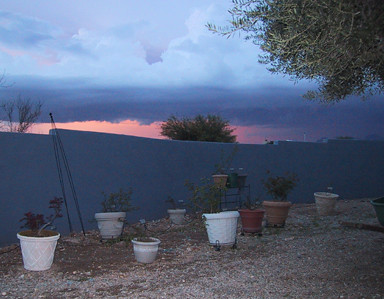
I had two inspirations. One was a wall I saw in a magazine that undulated instead of running straight. The second inspiration was my friend Abbie's ranch house in Patagonia which she painted a color that is not blue, purple or gray, but a mix of all three that matches the color of storm clouds. I fell in love with the way greens and pinks and apricots "pop" against its color. As you can see in the photograph, the color comes pretty close!
To celebrate, I moved my rose pots out from the backyard where they weren't getting enough sunlight. Now what to do with the rest of the yard?
Contractor: Larry Magda, a neighbor who is also a builder.
Subscribe to:
Posts (Atom)